IoT Water Infrastructure Monitoring: How Smart Pumping Stations Cut Costs by 15%
IoT water infrastructure monitoring enables water utilities to cut energy costs by 15% and reduce on-site inspections by 18%. This guide covers how remote monitoring works for pumping stations, how it compares to SCADA, and includes a real deployment case study from Guayaquil, Ecuador.


IoT water infrastructure monitoring is the use of connected sensors, industrial gateways, and cloud platforms to track the real-time status of water treatment plants, pumping stations, and distribution networks - without requiring on-site personnel. For water utilities managing dozens or hundreds of remote stations, it replaces reactive truck-roll inspections with continuous, automated visibility into pump status, energy consumption, flow rates, and equipment health.
The impact is measurable. In a deployment across 170+ water and wastewater stations in Guayaquil, Ecuador, IoT monitoring reduced energy costs by 15% and cut the need for on-site inspections by 18% — while eliminating paper-based processes entirely. This article explains how IoT water monitoring works, what infrastructure it requires, how it compares to traditional SCADA, and what a real-world implementation looks like from sensor to dashboard.
What Is IoT Water Infrastructure Monitoring?
IoT water infrastructure monitoring connects physical water assets — pumps, valves, treatment systems, storage tanks — to a centralized cloud platform through industrial sensors and communication networks. Operators see real-time data from every station on a single dashboard, receive instant alerts when readings fall outside normal ranges, and access historical trends for predictive maintenance and compliance reporting.
This approach differs fundamentally from manual inspections. Instead of dispatching technicians on scheduled rounds — often to sites where nothing is wrong — IoT monitoring surfaces problems the moment they occur. A pump drawing abnormal current, a rising water level in a wet well, or a pressure drop in a distribution line triggers an automated alert before it becomes a service disruption.
The core components of an IoT water monitoring system include:
- Field sensors — measuring parameters like pressure, flow rate, water level, pH, turbidity, motor current, and vibration. These connect to local controllers via protocols such as Modbus RTU, 4-20mA analog, or HART.
- Industrial IoT gateways — devices like Teltonika TRB-140, Advantech ADAM-6717, or Elastel EG324 that collect data from sensors and transmit it to the cloud over cellular (4G/LTE), LoRa, or Ethernet.
- Cloud IoT platform — software such as Ubidots that ingests, stores, and visualizes data through dashboards, manages alert rules, and provides APIs for integration with other enterprise systems.
- Alert and notification engine — SMS, email, or push notifications triggered by threshold violations, equipment faults, or communication loss.
For a deeper look at the types of IoT sensors used across industries, including water-specific sensors like pH, turbidity, and tank level, see our sensor guide.
How Does IoT Improve Water Pumping Station Operations?
IoT transforms pumping station operations by replacing blind, scheduled inspections with continuous, data-driven oversight. Operators know the exact status of every pump, motor, and sensor across their entire network — in real time, from any device.
Key Parameters Monitored
A typical IoT-enabled water pumping station tracks the following parameters:
| Parameter | Sensor Type | Why It Matters |
|---|---|---|
| Motor status (on/off) | Current transformer / relay | Detect failures immediately, track runtime hours |
| Amperage / current draw | Energy meter (e.g., Circutor) | Spot overloads, bearing wear, or dry-run conditions |
| Energy consumption (kWh) | Energy meter with Modbus | Track costs per station, identify efficiency losses |
| Water level (wet well) | Ultrasonic / pressure transducer | Prevent overflows, optimize pump cycling |
| Flow rate | Electromagnetic flow meter | Detect leaks, confirm pump performance |
| Pressure | Pressure transducer | Monitor distribution network integrity |
| Vibration | Accelerometer | Predictive maintenance — catch bearing failures early |
Communication Protocols: Modbus RTU, LoRa, and MQTT
Most water infrastructure already uses PLCs or controllers with Modbus RTU — a serial protocol that polls sensor registers over RS-485 wiring. IoT doesn't replace this field-level communication. Instead, an IoT gateway sits between the existing Modbus network and the cloud, translating register data into MQTT or HTTP payloads for transmission.
For stations spread across wide geographic areas, LoRa (Long Range) wireless provides connectivity where cellular coverage is unreliable or too expensive per site. LoRa sensors transmit data up to 15 km to a central gateway, which then forwards to the cloud over a single cellular or Ethernet backhaul.
This layered architecture — Modbus RTU at the field level, LoRa or cellular for backhaul, MQTT/HTTP to the cloud — means water utilities can retrofit IoT onto existing infrastructure without rewiring stations or replacing PLCs.
IoT vs Traditional SCADA for Water Utilities
Many water utilities already operate SCADA systems for centralized monitoring. The question isn't whether to monitor — it's whether to extend or replace legacy SCADA with cloud-based IoT platforms. Here's how they compare:
| Factor | Traditional SCADA | Cloud IoT Platform |
|---|---|---|
| Infrastructure | On-premise servers, dedicated network, licensed software | Cloud-hosted, SaaS model, no local servers |
| Upfront cost | $50K–$500K+ depending on scale | $500–$5K/month subscription |
| Deployment time | 6–18 months | Days to weeks per station |
| Remote access | VPN required, often limited | Any browser or mobile app, anywhere |
| Scalability | Adding stations requires network expansion | Add a gateway — station is online in hours |
| Maintenance | In-house IT team or vendor contract | Vendor-managed, automatic updates |
| Alerting | Control room operators, pager systems | SMS, email, push, webhook — configurable per user |
| Data retention | Limited by local storage | Years of cloud storage with API access |
| Best for | Large plants with real-time control loops | Distributed remote stations needing visibility and alerts |
For water utilities with hundreds of remote pumping stations — where the need is monitoring and alerting, not millisecond control loops — cloud IoT platforms offer faster deployment, lower cost, and easier scaling than extending a traditional SCADA system to every site.
The two approaches also coexist. Many utilities run SCADA at their main treatment plants while deploying IoT monitoring at distributed pump stations, lift stations, and storage tanks that were previously unmonitored.
Real-World Deployment: Interagua's Water Infrastructure in Guayaquil
Interagua manages the potable water and sewer systems for Guayaquil, Ecuador's largest city. Their infrastructure spans 3 water treatment plants, 68 potable water pumping stations, and 102 wastewater pumping stations — 173 sites across a sprawling urban and peri-urban network.
The Challenge: 170+ Stations With No Remote Visibility
Before IoT, Interagua had no remote monitoring across their pumping stations. When a pump failed, the only way to know was a scheduled inspection or a service complaint. Response teams dispatched on-site to diagnose issues — often traveling across the city to find a tripped breaker or a minor fault that could have been resolved remotely.
This reactive approach created compounding problems: delayed fault detection, prolonged resolution times, increased risk of sewage overflows, and technicians spending hours in transit instead of on high-value maintenance. The environmental and public health stakes were high — a wastewater pump failure in a dense urban area can cause sewage backups within hours.
The Solution: Modbus RTU + LoRa + Cloud Monitoring
Nextergy, an engineering firm based in Guayaquil specializing in automation and energy projects, designed the IoT monitoring system for a pilot pumping station. The architecture integrated energy sensors using Modbus RTU protocol with Circutor Pickdata controllers for data acquisition, LoRa communication for wireless backhaul, and Ubidots as the cloud IoT platform for dashboards, alerts, and reporting.
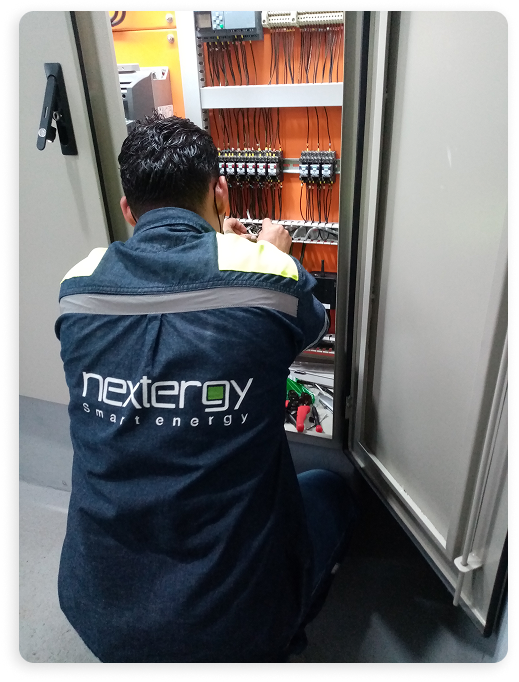
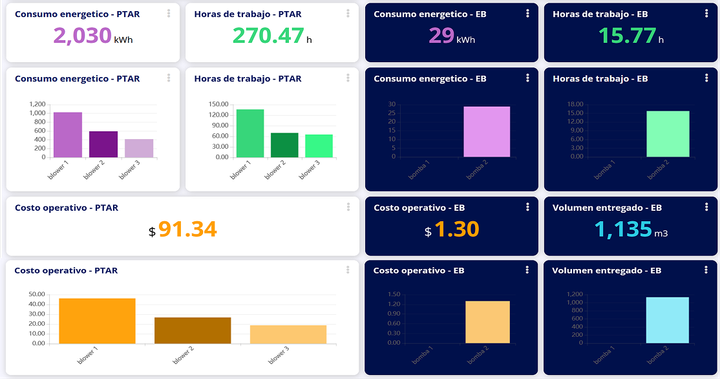
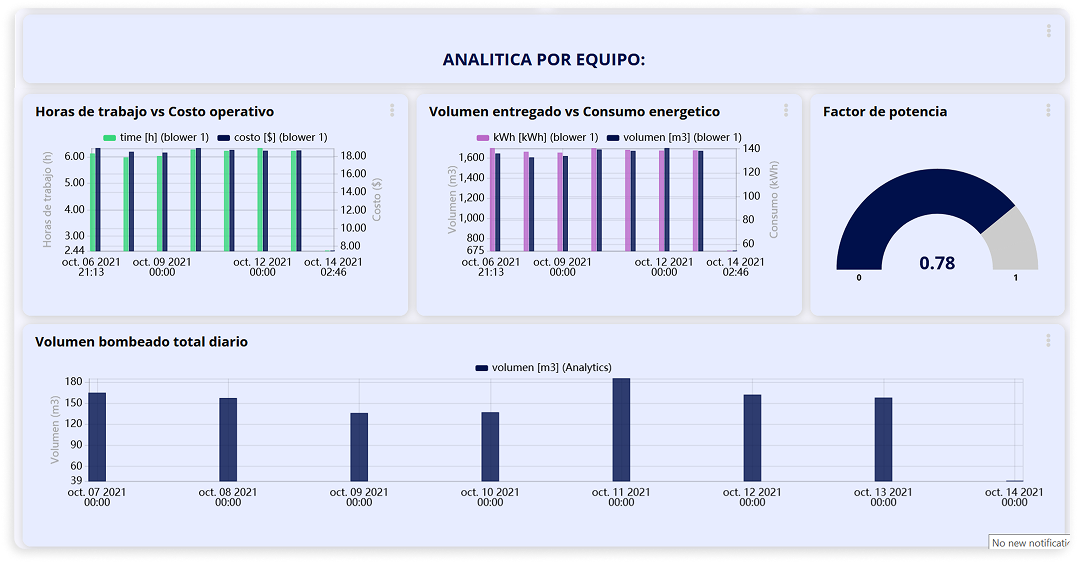
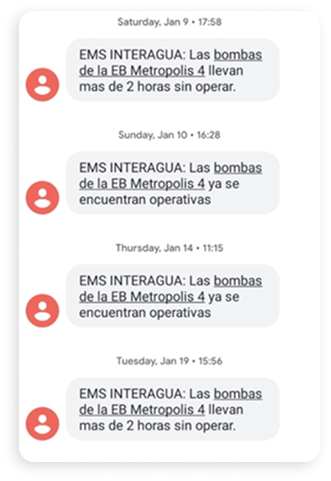
Through the Ubidots platform, Interagua gained real-time visibility into critical metrics: motor status (on/off), amperage draw, operating hours, energy consumption, and equipment activity logs. The alert engine sends instant SMS and email notifications when anomalies occur — an overcurrent condition, a pump offline longer than expected, or communication loss from a station.
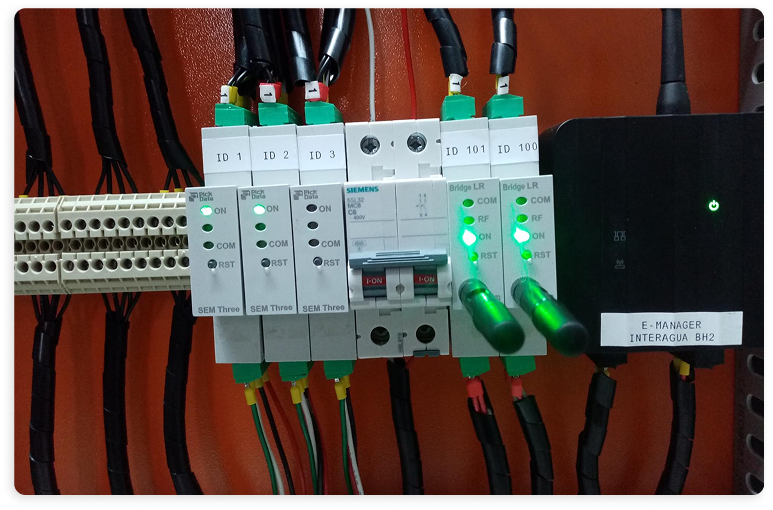
Nextergy built customized dashboards that gave operators a single-screen view of station health, with drill-down capability into individual pump performance and historical trends.
"What we value most about Ubidots is its flexibility and ease of integration, which allows us to quickly connect gateways and sensors across different projects. This gives us the confidence to deliver innovative projects in a short time, ensuring scalable and sustainable long-term solutions for our clients."
— Joselyne Del Rosario, General Manager at Nextergy
The Results: 15% Energy Savings, 18% Fewer Site Visits
The pilot deployment delivered measurable results:
- 15% reduction in energy costs — real-time consumption tracking exposed inefficiencies in pump scheduling and identified motors drawing more current than expected.
- 18% reduction in on-site working hours — maintenance teams shifted from routine inspection rounds to targeted, data-driven interventions.
- Elimination of paper-based processes — digital logs replaced manual record-keeping, improving auditability and reducing administrative overhead.
- Faster incident response — real-time alerts reduced the window between fault occurrence and team dispatch from hours (next scheduled visit) to minutes.
- Reduced overflow risk — continuous wastewater level monitoring provides early warning before stations reach critical capacity.
Interagua is now expanding the IoT monitoring system from the pilot station across their full network of 170+ sites.
How to Implement IoT Monitoring for Water Infrastructure
Deploying IoT monitoring across water infrastructure follows a consistent pattern, whether you're a utility, a system integrator, or an engineering firm building solutions for clients.
- Audit existing infrastructure. Identify which stations have PLCs or controllers (and what protocols they speak — typically Modbus RTU or Modbus TCP). Stations without controllers may need standalone IoT sensors with built-in connectivity.
- Select parameters to monitor. Start with the highest-impact data: pump status, energy consumption, and water levels. Expand to flow, pressure, vibration, and water quality as the system matures.
- Choose an IoT gateway. Match the gateway to your field protocol and backhaul needs. For Modbus RTU sites with cellular coverage, an industrial IoT gateway like the Teltonika TRB-140 or Advantech ADAM-6717 works well. For remote sites, consider LoRa-based architectures.
- Configure cloud platform and dashboards. Set up the IoT platform (e.g., Ubidots) to ingest data, define alert thresholds, and build operator dashboards. Start with a standard template per station type, then customize.
- Pilot on 1–3 stations. Deploy, validate data accuracy, tune alert thresholds to avoid false positives, and get operator feedback before scaling.
- Scale across the network. With a proven template, each additional station is a gateway installation and cloud configuration — deployable in hours, not months.
The key insight from successful deployments: start with monitoring and alerting, not control. Remote visibility alone — knowing that a pump is down, that energy consumption spiked, or that a wet well is rising — delivers the majority of the ROI. Remote control (starting/stopping pumps from the cloud) can be added later once the monitoring foundation is proven.
Frequently Asked Questions
How is IoT used in water management?
IoT connects water infrastructure — pumps, treatment systems, distribution pipes, storage tanks — to a centralized cloud platform through sensors and gateways. Operators monitor real-time data such as flow rates, pressure, water quality, and energy consumption from any device, receive automated alerts when readings are abnormal, and use historical data for predictive maintenance and compliance reporting.
What is the difference between SCADA and IoT for water utilities?
Traditional SCADA uses on-premise servers and dedicated networks for real-time control, while cloud IoT platforms use cellular or LoRa connectivity with cloud-hosted dashboards for remote monitoring and alerting. SCADA excels at millisecond control loops in treatment plants; IoT is faster and cheaper to deploy across distributed remote stations like pump houses and lift stations. Many utilities run both — SCADA at the plant, IoT at the remote sites.
What sensors are used in IoT water monitoring?
Common sensors include pressure transducers, electromagnetic flow meters, ultrasonic level sensors, pH and turbidity probes, energy meters (for pump consumption), current transformers (for motor status), and vibration sensors (for predictive maintenance). Most connect to local controllers via Modbus RTU, 4-20mA analog, or HART protocols.
How does remote monitoring reduce costs for water utilities?
Remote monitoring eliminates scheduled inspection trips to sites where nothing is wrong — technicians only travel when data indicates an actual issue. Energy monitoring identifies pumps running inefficiently or outside optimal schedules. In one deployment across 170+ stations, IoT monitoring reduced energy costs by 15% and cut on-site working hours by 18%.
What is the ROI of IoT for water infrastructure?
IoT water monitoring typically pays for itself within 6–12 months through reduced energy waste, fewer emergency dispatches, and lower labor costs for routine inspections. The Interagua deployment in Guayaquil projects 15% energy savings and 18% labor reduction in its first phase — with additional savings expected as the system scales from a pilot to 170+ stations.
How much does IoT water monitoring cost?
Hardware costs range from $200–$800 per station (gateway + sensors), depending on the number of parameters monitored and connectivity method. Cloud platform subscriptions typically run $500–$5,000/month depending on the number of devices and features required. Compared to extending traditional SCADA to remote sites ($50K+ per station), IoT monitoring is 10–50x cheaper to deploy per location.